















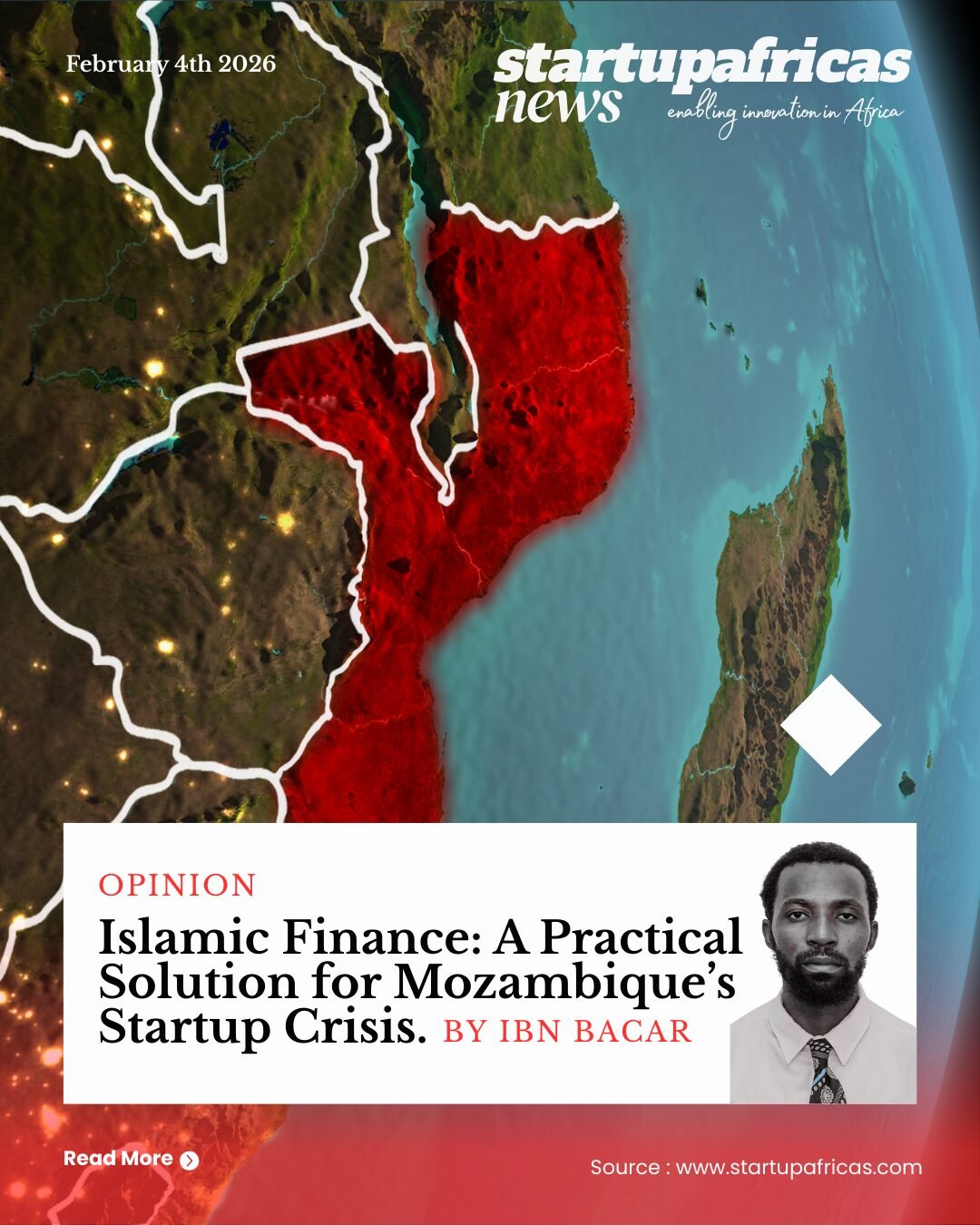
Mozambique’s startup ecosystem is not failing for lack of talent or ideas. It is failing because the financing model is broken. Entrepreneurs across Maputo, Beira, and Nampula face banks that demand impossible collateral, high-interest loans disconnected from business realities, and donor programs that are bureaucratic, episodic, and unsustainable.
Across much of Africa, startups confront the same paradox: human capital is abundant, but financial capital is structured to minimize risk for the financier, not to nurture innovation. Conventional debt imposes all risk on the entrepreneur while offering financiers fixed returns regardless of the outcome. This system penalizes experimentation, stifles growth, and perpetuates the chronic undercapitalization of promising ventures.
Islamic finance offers an alternative, not a niche ethical choice, but a structural correction. Central to this approach are Mudarabah and Musharakah, classical instruments of profit-and-loss sharing that align capital with real economic activity.
Asset-Backed Financing: Linking Capital to Reality
One of the most important characteristics of Islamic finance is that it is asset-backed. Unlike conventional banks, which deal in money and monetary instruments alone, Islamic financing requires that capital be invested in tangible assets or productive ventures. Profits are earned from real economic activity, and losses are borne proportionally by investors.
As Taqi Usmani explains in An Introduction to Islamic Finance, “Financing on the basis of Mudarabah and Musharakah does never mean the advancing of money. It means participation in the business… an investor must share the loss incurred by the business to the extent of his financing.”
This distinction is critical for startups. By tying financing to actual assets and operations, Islamic finance aligns incentives between investor and entrepreneur: both succeed when the business succeeds, and both share the consequences of failure. Risk is no longer externalized; it is mutually managed, creating a more sustainable growth environment.
Mudarabah: Angel Investment, Reimagined
Mudarabah is a partnership where one party provides capital (the rabb al-māl) and the other provides management and expertise (the mudarib). Profits are shared according to pre-agreed ratios, while losses are borne by the financier, except in cases of negligence.
Functionally, Mudarabah mirrors angel investment or seed capital. But unlike conventional venture financing, it ethically enforces shared risk: investors cannot demand fixed returns without exposure to the venture’s success, and entrepreneurs are empowered to innovate rather than burdened with debt repayment schedules.
For Mozambican startups, this model could finance everything from single import-export transactions to early-stage fintech platforms, allowing innovation to thrive without the constant threat of insolvency.
Musharakah: Equity with Accountability
Musharakah is a joint investment model where all partners contribute capital and share profits and losses according to agreed ratios. Unlike conventional equity schemes, Islamic law explicitly integrates risk, governance, and participation.
This model is versatile: it can finance projects, working capital, or single transactions. Non-cash assets can be included as capital, and profit-sharing ratios can be negotiated flexibly.
Usmani emphasizes that “the partners are at liberty to determine, with mutual consent, the ratio of profit allocated to each… however, the loss suffered by each partner must be exactly in proportion to his investment.”
In practice, Musharakah enables Mozambican entrepreneurs to access capital without surrendering control, while investors gain returns that reflect actual performance rather than fixed interest. It encourages patient, value-driven investment, a stark contrast to speculative or extractive conventional capital.
Africa’s Opportunity: Aligning Capital and Innovation
Mudarabah and Musharakah are not only ethical frameworks; they are pragmatic economic tools. They solve a problem that conventional finance cannot: the misalignment of risk and reward in early-stage ventures. By embedding risk in capital and linking returns to real performance, these instruments foster innovation, shared responsibility, and resilient ecosystems.
Mozambique is particularly well-positioned for this shift. Its history of trade along the Swahili coast, its entrepreneurial youth, and its growing private sector provide fertile ground for profit-and-loss sharing models that are both culturally resonant and economically effective.
A Structural Correction, Not a Religious Option
Islamic finance is often framed as a moral or religious alternative. That is too narrow. For Africa, it is a corrective mechanism. Mudarabah and Musharakah address the structural failures of conventional debt-based financing: they encourage entrepreneurs, align investor incentives with actual outcomes, and embed accountability and transparency in capital allocation.
For Mozambique and other African economies, adopting these instruments could transform the startup landscape, enabling ventures to grow sustainably, attract responsible investment, and create jobs, all without relying on extractive debt or speculative capital.
The question is no longer whether Islamic finance can work for African startups. It is how long we can afford to ignore a system that links capital, risk, and value creation in a fundamentally fair way.