














The Democratic Republic of Congo (DRC) has unveiled an ambitious €8 billion ($8.8 billion) digital transformation plan for 2026–2030, aimed at expanding connectivity, modernising infrastructure and positioning the country as a regional technology hub.
Here’s what the strategy includes and who stands to benefit.
1. Telecom and Broadband Expansion
Connectivity is the backbone of the plan.
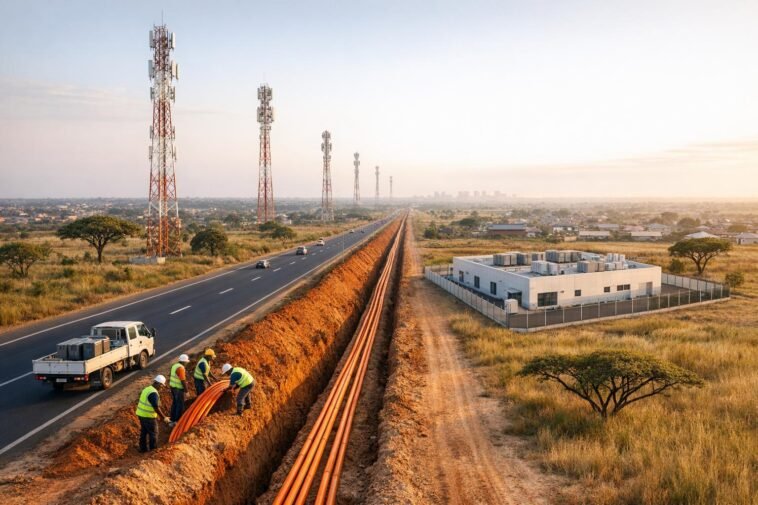
Currently, the DRC operates about 5,150 telecom towers — far too few for a country of 112 million people spread across a vast territory. The new strategy targets at least 30,000 towers by 2030, covering all 145 territories.
Connecting 650 Communities
- Broadband expansion to 650 communities
- 30 million people and 1,000 institutions to gain access
- National fiber-optic network to grow from 6,000 miles to over 31,000 miles
- Universal Service Development Fund (FDSU) targeting 68 million rural residents over 10 years
Internet penetration currently sits below 30%, leaving nearly 80% of the population offline. The infrastructure push aims to close that gap.
Solar-Powered Telecom Towers
With only 19% of the population connected to the electricity grid, power remains a major constraint.
To address this, 2,000 solar-powered base stations will be deployed, particularly in remote areas. From January 2025, Vodacom DRC and Orange DRC began a six-year rollout, starting with 1,000 sites offering 2G and 4G services.
The shared infrastructure model reduces capital costs and is expected to extend coverage to 19 million additional people.
Mobile Internet Growth
- 9.7 million new mobile internet users projected
- Mobile penetration reached 32.2% by September 2025
- Average data cost: $0.88 per GB
By encouraging tower-sharing and competition, the plan aims to make connectivity more affordable in underserved areas.
2. Infrastructure and Data Centers
Beyond telecom towers, the strategy strengthens digital sovereignty and advanced computing capacity.
Tier 3 Data Center in Kinshasa
In October 2025, the government signed a $150 million agreement with United Investment LMT to build three data centers nationwide, including a flagship Tier 3 facility in Kinshasa.
Key features:
- AI-ready infrastructure
- National cybersecurity center
- Local hosting of state data (reducing reliance on foreign servers)
- Support for the “Sphere of Artificial Intelligence” initiative
Technical specifications are being developed with UAE-based firm The Founding.
Fiber-Optic Backbone
The government plans to deploy between 60,000 and 80,000 kilometers of fiber across all 145 territories.
Minister José Mpanda Kabangu emphasized that at least 40,000–50,000 kilometers are required for full national connectivity.
The plan also includes a new submarine cable with 192 terabits per second capacity to boost international bandwidth.
3. Digital Government Platforms
The digital overhaul extends to public administration.
Planned reforms include:
- DRC Pass – a blockchain-based digital ID system
- Online tax portal
- Customs single window
- National interbank payments platform (launching March 2026)
These systems aim to:
- Improve tax compliance
- Increase transparency
- Boost direct tax revenue by 1.2–1.3% of GDP
- Simplify business-government interaction
4. Training and Job Creation
Human capital development is central to the plan.
In September 2025, the government partnered with Cisco and Cybastion to train 250,000 young people over five years in:
- Artificial Intelligence
- Cybersecurity
- Data science
- Programming
- Digital entrepreneurship
Airtel DRC will provide free internet access to trainees.
Employment Projections
- 700,000 direct jobs under the digital plan
- 1.7 million jobs in digitized agriculture
- 500,000 in services
- 300,000 in industry
The program targets 50% female participation to promote gender inclusion.
5. Economic Impact
By 2029, the digital expansion is expected to:
- Add $4.1 billion to GDP
- Generate $3.6 billion in economic value across mining, agriculture and public services
- Increase competitiveness of the private sector
The government has committed $1 billion in public funding, with $500 million already secured from international partners including the World Bank and the European Union, alongside private sector participation.
6. Who Benefits?
Startups and Fintech
- Access to 30 million new broadband users
- National interbank payments system
- Local data hosting infrastructure
- Policy support for AI-driven innovation
Telecom Companies
- Shared infrastructure lowers expansion costs
- Massive untapped rural market (80% offline population)
- Faster regulatory alignment
Businesses
- Simplified tax and customs processes
- Reduced foreign hosting expenses
- Improved digital payment systems
Young Professionals
- Access to structured digital skills training
- Internship pathways
- Opportunities in cybersecurity, AI and data science
Strategic Positioning: A Regional Tech Hub
The government’s long-term vision is to transform DR Congo into a regional digital gateway, leveraging:
- Its central geographic location
- Vast reserves of critical minerals essential for global energy and digital transitions
- Sovereign data infrastructure
- A new generation of digitally trained youth
If executed effectively, the €8 billion program could redefine DR Congo’s economic trajectory, shifting it from a resource-dependent economy toward a digitally enabled growth model.
The real test now lies in implementation, transparency and sustained private sector participation.